
“Don’t gamble,” Will Rogers said. “Take all your savings and buy some good stock and hold it till it goes up, then sell it. If it don’t go up, don’t buy it.”1
The Psychology Behind Hindsight Bias
The psychologist Baruch Fischhoff, who introduced us to hindsight shortcuts and errors, wrote, “In hindsight, people consistently exaggerate what could have been anticipated in foresight. … People believe that others should have been able to anticipate events much better than they actually did. They even misremember their own predictions so as to exaggerate in hindsight what they knew in foresight.”2
Hindsight errors are the belief that whatever happened was bound to happen, as if uncertainty and chance were banished from the world. So, if an introverted man marries a shy woman, it must be because, as we have known all along, “birds of a feather flock together,” and if he marries an outgoing woman, it must be because, as we have known all along, “opposites attract.”
Similarly, if stock prices decline after a prolonged rise, it must be, as we have known all along, that “trees don’t grow to the sky,” and if stock prices continue to rise, it must be, as we have equally known all along, “the trend is your friend.”
Hindsight errors are a serious problem for all historians, including stock market historians. Once an event is part of history, there is a tendency to see the sequence that led to it as inevitable. In hindsight, poor choices with happy endings are described as brilliant choices, and unhappy endings of well-considered choices are attributed to horrendous choices.
Yet not all hindsight is about errors. Indeed, good hindsight shortcuts serve as good instructors, teaching us to repeat actions that brought good outcomes and avoid actions that brought bad ones. We studied for exams and aced them. We learned that acing exams is the likely outcome of studying for exams.
Distinguishing Between Hindsight Shortcuts and Errors
Hindsight shortcuts are always precise when one-to-one associations exist between past and future events, actions and outcomes, and causes and consequences. However, hindsight shortcuts can easily turn into hindsight errors where randomness and luck are prominent, loosening associations between past events and future events, actions and outcomes, and causes and consequences.
Hindsight errors might arise from unawareness of the influence of randomness and luck or from a desire to see the world as predictable, devoid of randomness or luck.
We ace an exam without studying when luck is good and exam questions match whatever we remember from the few classes we attended. But when luck is bad, we fail the exam and perhaps the course. Hindsight errors can mislead lucky students into thinking that they can ace exams without studying and can mislead unlucky students into thinking that studying for exams is futile.
Hindsight errors underlie consequence-cause matching. We err by inferring causes from consequences we know only in hindsight, as if we had known these consequences in foresight. People inferred that a computer crash had a large cause, such as a widespread computer virus, if it had a large consequence; for example, Adam lost his job. However, they inferred that the identical failure was more likely to have a smaller cause, such as a cooling fan malfunction, if the consequence was small; for example, Adam graduated on time. Yet the consequence gave no information about what caused the crash.3
In a 2017 Wall Street Journal article, I noted the need for diversification because of the difficulty of identifying winning investments in foresight.4 A reader objected. “Look at it this way,” he wrote. “Start with 10 funds to choose from,” and “weed out at least half of the managers as poor performers. … Now select the ‘average’ from among those left … and you’ll end up in the top quartile and beat the market.”
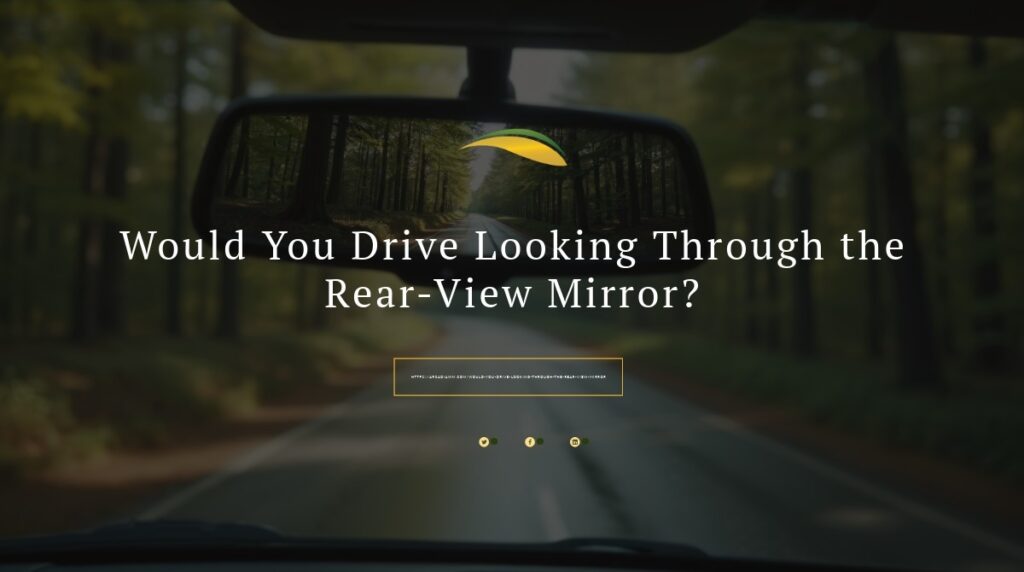
Another reader, however, noted the error of hindsight. “Do you drive your car by looking through the windshield or the rear-view mirror?”
Correcting Hindsight Errors: Practical Approaches
An adviser shared with me a method she uses to correct clients’ hindsight errors. At the first meeting each year, she asks clients questions about the coming year and asks them to make forecasts. The questions are along the lines of the following:
- Will U.S. stock funds outperform international stock funds?
- Will a magnitude 7.0 or higher earthquake strike California?
- Will Nicolas Maduro cease to be president of Venezuela?
At the end-of-the-year meeting, clients might be tempted by hindsight to bring up forecasts that came true: “Why did you hold any weight in small-caps when we knew with foresight that large-caps would outperform?” or “Why didn’t you invest more of my money in international stock funds when we could clearly see the signs that they were ready to have a better year than U.S. stock funds?”
At that point, the adviser will take out the list and educate her clients about the difference between hindsight and foresight and the pitfalls of hindsight errors.
Sources
- Benjamin Graham, The Intelligent Investor, updated with new commentary by Jason Zweig (New York: Harper Business Essentials, 2003), 368.
- Baruch Fischhoff, “Debiasing,” in Judgment Under Uncertainty: Shortcuts and Biases, ed. Daniel Kahneman, Paul Slovic, and Amos Tversky (Cambridge, UK: Cambridge University Press, 1982), 422–44.
-
Robyn A. LeBoeuf and Michael I. Norton, “Consequence-Cause Matching: Looking to the Consequences of Events to Infer Their Causes,” Journal of Consumer Research 39, No. 1 (June 2012): 128–41.
-
Meir Statman, “A Different Kind of Financial-Literacy Test,” Wall Street Journal, October 23, 2017.
-
Ellen Peters, Mary Kate Tompkins, Melissa A.Z. Knoll, Stacy P. Ardoin, Brittany Shoots-Reinhard, and Alexa Simon Meara, “Despite High Objective Numeracy, Lower Numeric Confidence Relates to Worse Financial and Medical Outcomes,” Proceedings of the National Academy of Sciences 116, No. 39 19386-19391 (2019).
Download a PDF of this article
Download the October 2025 Market Review
This article was provided by Avantis Investors and we have been given permission to share this information with our clients and potential clients.