


While recent financial news headlines have given a great deal of attention to the slate of expected U.S. mega-cap IPOs, a few relevant storylines may have slipped under investors’ radar.
Despite geopolitical and economic uncertainty in the first five months of 2026, global stock market indexes have quietly posted solid results. The S&P 500® Index is up more than 11% on the year, while non-U.S. stocks (measured by the MSCI ACWI ex-USA IMI Index) are up more than 14%. That’s likely to mean many investors may be pleasantly surprised by their portfolios thus far.
Another upcoming event to watch is the annual FTSE Russell index reconstitution, scheduled for the fourth Friday in June.1 On that day, Russell will reclassify the holdings in its U.S. indexes for the first time since last June.
 Stocks will be placed in the various indexes based on the underlying firm’s characteristics, such as its market capitalization, the price multiple at which it trades relative to its book value, or changes in its earnings. Figure 1 summarizes notable changes coming to commonly watched Russell U.S. indexes.
What may seem like routine index maintenance can have real implications for investors. When Russell reconstitutes its indexes, funds and investors attempting to track those indexes must place trades to:
- Sell securities leaving each index.
- Buy securities joining each index.
- Buy or sell securities to adjust the old weights of securities staying in each index to their new weights.
Given the substantial assets in funds tracking Russell’s U.S. market indexes (estimated at more than $12 trillion as of June 2025), this annual event triggers significant single-day turnover for those funds and their investors.
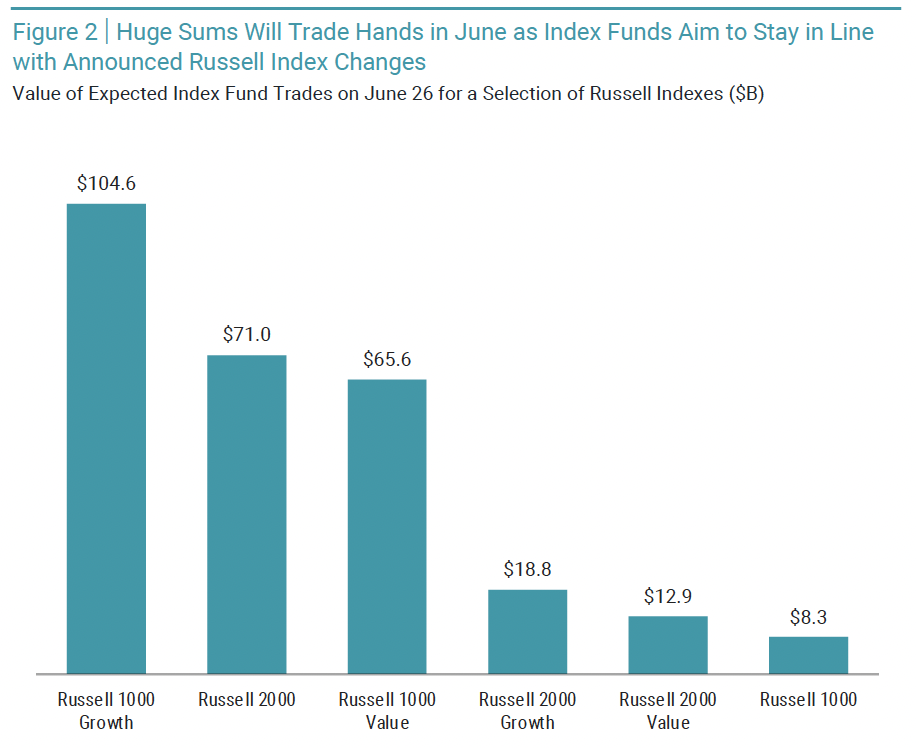 As a result of the reconstitution, Jefferies anticipates about $350 billion in trades at the end of the day on June 26, driven solely by index funds, up from about $220 billion traded around the 2025 Russell reconstitution. Figure 2 presents the expected dollar amount that index funds tracking various Russell indexes will trade.
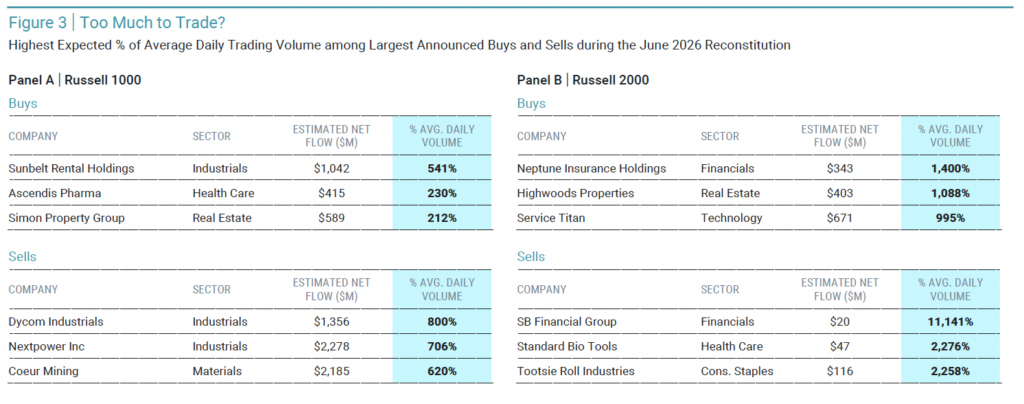
The considerable trading activity triggered by the Russell reconstitution makes this one of the highest aggregate trading volume days in the U.S. market each year. The impact on traded volume at the individual security level can also be significant, not just in small-caps, where average trading volumes tend to be lower.
As shown in Figure 3, many names moving between indexes or changing weights will need to trade at volumes hundreds or thousands of times higher than typical for these stocks.
The data prompts an important question: Does it really make sense to force all this trading into a single day? Most would agree that attempting to trade multiples of a security’s typical volume should come at a cost.
If an index fund is required to buy or sell stocks in order to closely track its benchmark, what motivates the other side of the trade to participate? Price is often that incentive, and it typically means paying higher prices for the stocks that need to be acquired and lower prices for the stocks that need to be sold.
Several studies have sought to measure the impact of high liquidity demands around index rebalance events. For example, one study estimated that funds tracking the Russell 2000 Index lost between 1.30% and 1.84% per year as a result of the liquidity demands around its annual reconstitution and related investor arbitrage activity (i.e., investors buying securities known to be demanded by index funds to earn a profit from their need for immediacy at reconstitution).2 While various studies on different samples may yield varying results, what’s clear is that the unseen costs of infrequent index rebalancing can be meaningful.
Now, back to those highly anticipated mega-cap IPOs painting headlines. This same liquidity-demanding dynamic is likely to be at play as index providers respond to the inclusion of these companies in market indexes. New IPO inclusion rule changes for Russell and other index providers may exacerbate the impact on index fund investors.
Russell recently announced plans to “fast-track” the inclusion of large IPOs such as SpaceX, Anthropic, and OpenAI. Companies that meet the fast-track requirements (e.g., those within the size range of the 500 largest companies) will be eligible for inclusion after five trading days.
This fast-tracking approach has precedent. The Center for Research in Security Prices (CRSP) has fast-tracked larger IPOs (inclusion after five trading days) since 2017, providing a dataset for research into the potential impacts of index providers adopting a similar approach.
A 2025 study found that fast-tracked IPOs, on average, outperformed non-fast-tracked IPOs by more than 5% from the IPO close date through the index inclusion date (the 5th trading day). After being added to the indexes (and index funds tracking them), price gains quickly reverted on average.
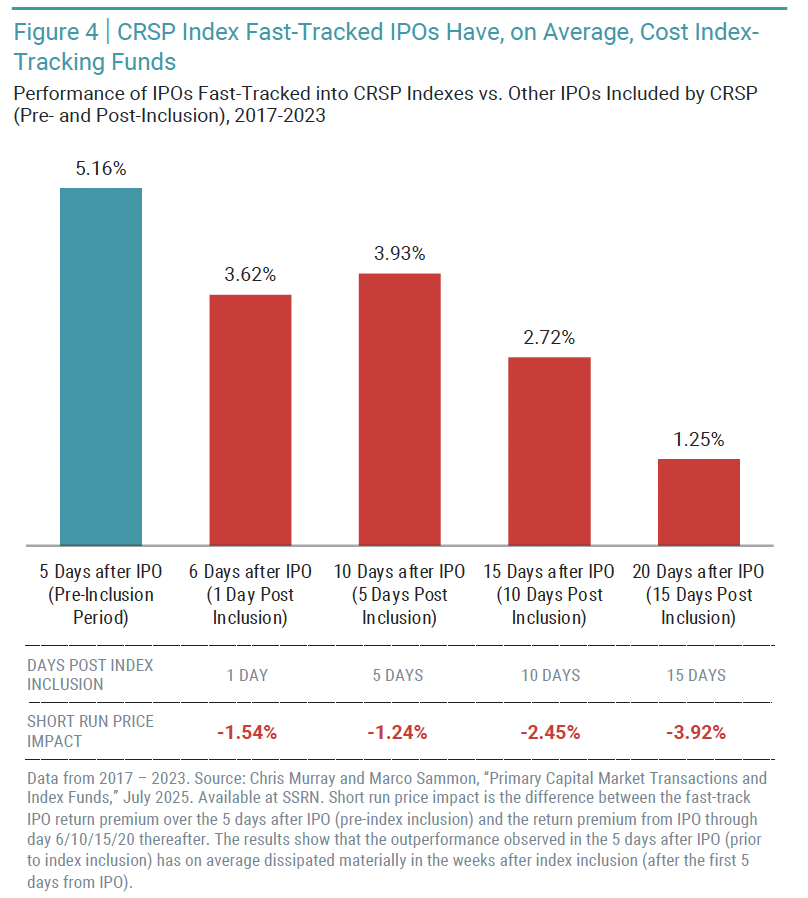 Figure 4 summarizes the findings over the sample from 2017 through 2023. While a relatively small sample, the results suggest investors may buy up shares of popular IPOs, knowing that index fund managers will soon have strong demand to acquire them to keep their funds in line with the index they track.
These hidden potential costs, whether from recurring index rebalancing events or new IPO inclusions, are often unknown to index fund investors, yet research shows they can be meaningful. Importantly, it’s not the only option.
We believe investors can do better by avoiding purchases of companies around the time they’re announced for addition to market indexes. This helps mitigate the risk of buying at elevated prices that often accompany high short-term demand for these securities.
Further, a process that allocates investor assets based on current (rather than stale) information to determine which securities to buy or sell and at what weights is expected to add value over time. This doesn’t mean investors have to trade a lot each day, only what’s necessary to keep the portfolio in the desired position. This method allows for consistent focus on the desired asset class rather than forced trades made only once or twice a year.
Download a PDF of this article
Download the June 2026 Market Review
This article was provided by Avantis Investors and we have been given permission to share this information with our clients and potential clients.